Finishing
To power float a concrete floor, wait until the bleed water has evaporated and the slab bears your weight leaving only a shallow footprint, then run a float pan or flat blades over the whole surface in overlapping passes to flatten and close it. As the slab stiffens, make repeated passes with the blades pitched progressively steeper, working the edges and corners by hand, until the concrete takes on a dense, smooth, hard-wearing finish.
Power floating and trowelling turn a screeded concrete slab into a dense, smooth, hard-wearing surface. Working the surface with a rotating float or set of steel blades presses the top layer tight, drives out minor undulations, and brings a fine film of cement paste to the top. Passed over repeatedly as the slab hardens, that worked surface becomes progressively denser and more abrasion-resistant, finishing to a flat, closed, burnished sheen that stands up to traffic far better than a screeded-only floor. Lievers Holland has designed and built concrete compaction and finishing machinery in Mijdrecht, the Netherlands, since 1954, and the sequence below is how we recommend approaching the job.
Timing is the single biggest factor in a good finish, and it is judged on site rather than by the clock. Start too early and the machine tears and marks a slab that is still too soft; start too late and the surface has hardened beyond the point where it can be worked. As a general guide, the slab is ready when the bleed water has risen and fully evaporated, the surface has lost its wet sheen, and the concrete bears your weight leaving only a shallow footprint — roughly 3 to 5 mm. From that point the window stays open as the slab continues to stiffen, which is exactly what the later trowelling stages need. Ambient temperature, humidity, wind and the mix design all shift the timing, so watch the slab, not the watch.
Power finishing runs in two stages. Floating (or panning) comes first: a wide float pan or a set of flat blades flattens the surface, embeds the aggregate, and opens the concrete so any remaining bleed can escape. Trowelling follows once the slab has firmed up: the blades are pitched progressively steeper over successive passes to compact and burnish the surface into a harder, tighter finish. The move from flat floating to steeper trowelling is gradual — you raise the blade angle a little on each pass as the concrete stiffens, never jumping straight to a steep pitch on a soft slab.
The finish is built up through overlapping passes rather than a single sweep: overlap each run so no strip is left unworked, and alternate the direction of successive passes so the machine flattens ridges instead of following them. Edges, corners and tight spots that the machine cannot reach are worked by hand and kept level with the floated area, so the whole floor firms up together. Above all, let the slab dictate the pace — several light, well-timed passes as the concrete stiffens produce a far better result than trying to force a finish in one go.
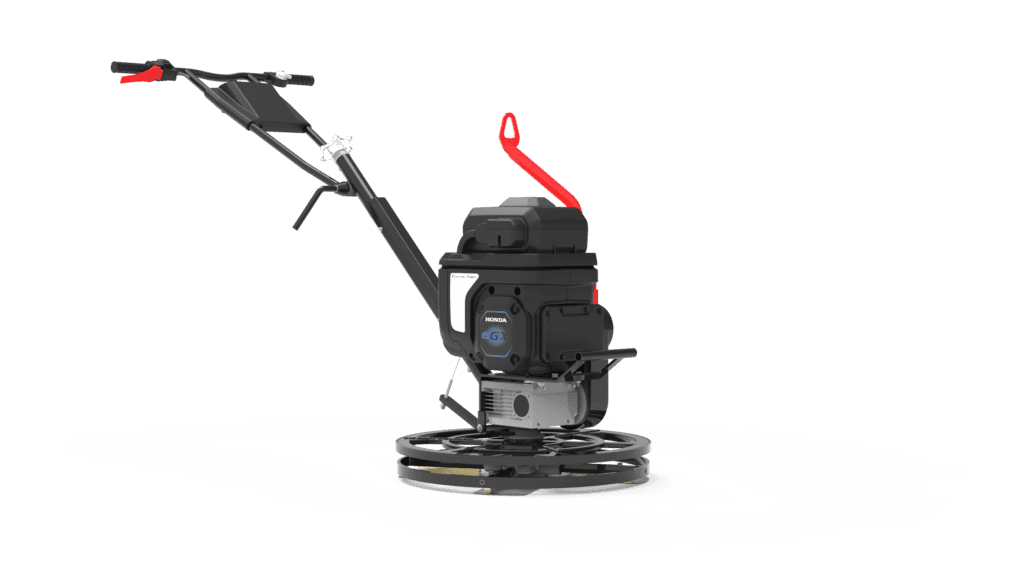
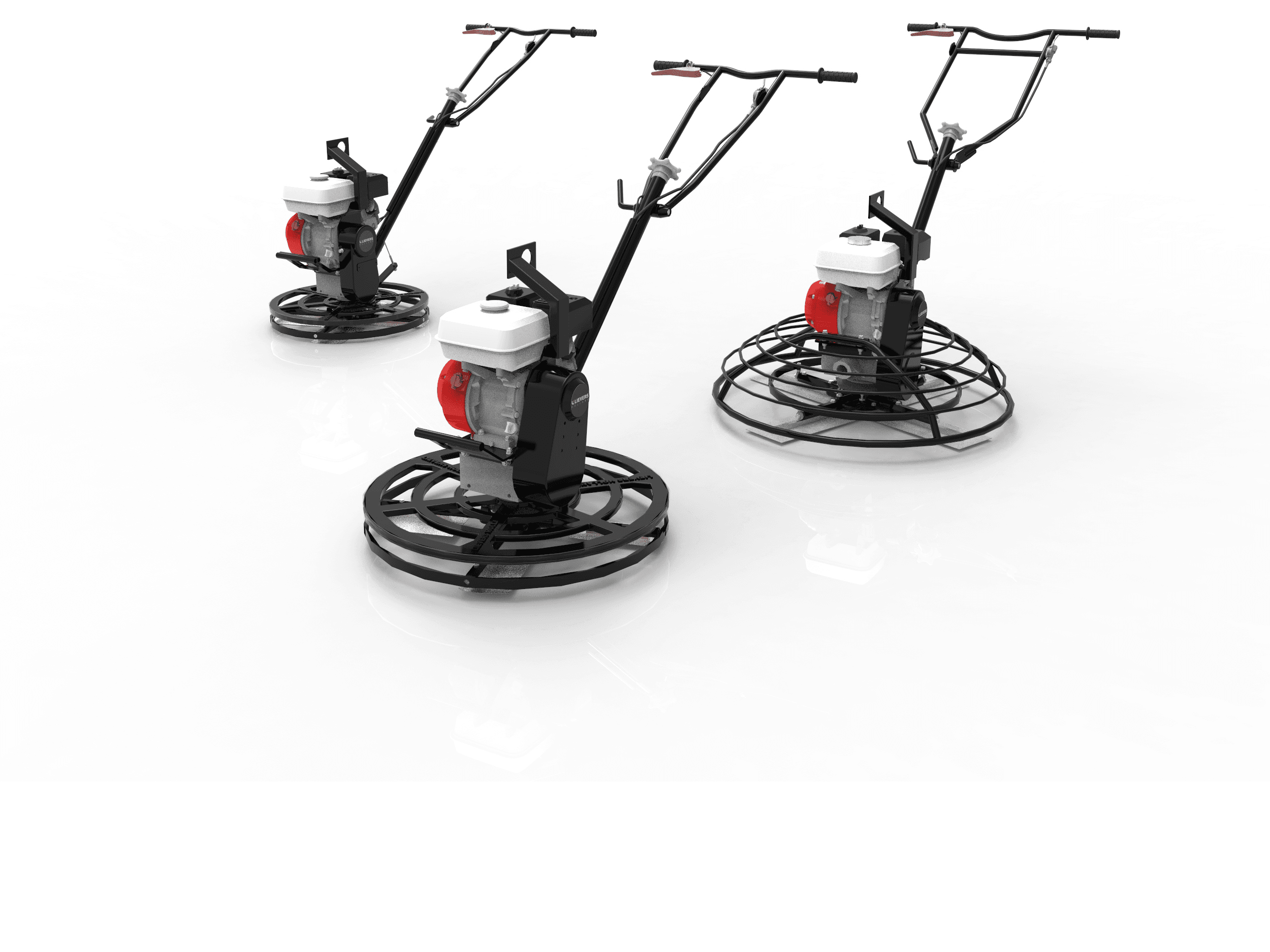
The area of the pour decides the machine. A walk-behind (pedestrian) power float suits smaller floors, bays, rooms and areas with lots of edges and obstructions, where its single rotor is easy to steer into corners. Large open slabs — warehouse and industrial floors covering hundreds or thousands of square metres — are finished far more efficiently with a ride-on trowel, whose twin counter-rotating rotors cover ground quickly and hold a consistent finish across a big pour. On many jobs both are used together: a ride-on takes the open field while a walk-behind and hand tools work the edges.
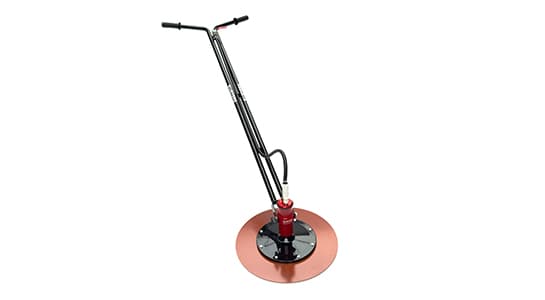
Drive type matters too. Most power floats run on a petrol engine, but enclosed spaces, tunnels and areas with any explosion or fire risk need a spark-free, emission-free alternative. Lievers' LAP-45 is a pneumatic power float driven by an air motor rather than a combustion engine, so it produces no exhaust and no sparks and can be used safely where a petrol machine cannot. Its stepless speed control, from zero up to full working speed, lets the operator match the disc speed to the state of the concrete as the slab stiffens through the finishing stages.
Free advice
Our engineers in Mijdrecht think along about machine choice, concrete and planning — answer within one working day.
About the author
Lievers Holland has designed and manufactured concrete compaction and finishing machinery in Mijdrecht, the Netherlands, since 1954. Our guides are written by the same engineering team that builds the machines.
Wait until the bleed water has evaporated and the slab bears your weight leaving only a shallow footprint, then float the whole surface with a pan or flat blades to flatten and open it. As the slab stiffens, switch to trowel blades and make repeated overlapping passes, raising the blade pitch a little each time, while finishing edges and corners by hand — until the surface is dense, smooth and burnished.
Start when the bleed water has risen and fully evaporated, the surface has lost its wet sheen, and the concrete bears your weight leaving only a shallow footprint of about 3 to 5 mm. This is judged on the slab itself, not by a fixed time, because temperature, humidity, wind and the mix all change how fast the concrete is ready. Too early and the machine tears the surface; too late and it has hardened beyond working.
Float pans and flat blades come first: run nearly flat, they flatten the surface, embed the aggregate and open the concrete so any remaining bleed can escape. Trowel (finishing) blades come later and are pitched progressively steeper to compact and burnish the stiffening slab into a harder, smoother, denser finish. In practice you float first, then move to trowelling and raise the blade angle pass by pass.
A floor is finished over multiple passes rather than one. You float the surface, then make several trowelling passes as the slab hardens, overlapping each pass and ideally working at right angles to the previous one, raising the blade pitch a little each time. The exact number depends on the concrete and the finish required; keep going until the surface is uniformly closed and burnished, then stop before you over-work it.
Match the machine to the area. A walk-behind (pedestrian) float suits smaller floors, bays and areas with lots of edges and obstructions, where it is easy to steer into corners. A ride-on trowel, with twin counter-rotating rotors, covers large open industrial slabs far more efficiently and holds a consistent finish. On big pours the two are often used together, with hand tools for the edges.
Yes, but a petrol-engined machine produces exhaust and sparks that are unsafe in enclosed, poorly ventilated, or explosion- or fire-risk areas. A pneumatic power float such as the Lievers LAP-45 is driven by an air motor instead of a combustion engine, so it makes no exhaust emissions and no sparks and can be used safely in those environments, with stepless speed control to match the concrete as it stiffens.
 How-to
How to judge the right moment to trowel or power float concrete — the bleed-water and footprint readiness tests, why timing is critical, the finishing sequence, and how weather and mix design shift the window.
Read articleExplainerA plain-language explainer covering what a power float (power trowel, "concrete helicopter") is, the difference between float pans and finishing blades, how the machine works, the finish it produces, walk-behind versus ride-on types, and petrol, electric and pneumatic power options.
Read article