Finishing
A power float — also called a power trowel or "helicopter" — is a machine that spins one or more steel blades or a flat pan over a fresh concrete slab to compact, flatten and burnish the surface. As the blades rotate, they press and polish the top layer of concrete into a flat, dense, hard-wearing finish. It is the standard tool for producing smooth, durable floors in warehouses, factories and other large concrete areas.
A power float is a powered machine that finishes the surface of a fresh concrete slab. One or more blades — or a flat disc called a float pan — rotate under a motor and sweep across the concrete, pressing the top layer flat and smooth as they turn. The action compacts the surface paste, closes it up and burnishes it, leaving a level, dense, hard finish once the slab cures.
The same machine goes by several names, which is where a lot of confusion comes from. "Power float" and "power trowel" are the most common terms in English; on site the machine is often nicknamed a "concrete helicopter" because the spinning blades look like rotor blades from above. In other markets you will hear zacieraczka do betonu (Polish) or Flügelglätter (German) for the same tool. At Lievers we have designed and built concrete finishing machinery in Mijdrecht, the Netherlands, since 1954, and we still hear all of these names used interchangeably.
In everyday use, "power float" and "power trowel" mean the same machine — the words are used interchangeably across the industry. Where it helps to be precise is in the two jobs the machine does and the two attachments it uses:
So one machine, two stages: float first with the pan, then finish with the blades.
Mechanically the idea is simple. A motor drives a central rotor — the "spider" — that carries the blades or pan. The rotor spins the blades flat against the concrete, and the machine glides over the surface on that cushion of turning steel. On a walk-behind machine the operator tilts the whole unit slightly to steer it; on a ride-on machine, twin rotors and a set of controls do the same job across a much wider path.
As the slab cures and hardens, the operator increases the blade pitch — the tilt of the blades against the surface. Flat blades float a soft surface gently; steeper blades burnish a hardened surface to a tight sheen. Matching the pitch and timing to how the concrete is setting is what separates a good floor from a poor one.
The goal is a floor that is flat, dense, hard and smooth, with low surface porosity. Compacting and burnishing the top layer closes the pores in the concrete, which makes the surface more resistant to abrasion, dust and liquids, and easier to clean. A well-trowelled floor stands up to forklift traffic, pallet racking and daily wear far better than one left with only a screeded finish. That is why power floating is standard for industrial floors, warehouses, distribution centres, factories and large commercial slabs.
There are two broad families. A walk-behind (single-disc) power float has one rotor and is guided by an operator walking behind the handle. It is the practical choice for smaller areas, edges, and spaces the operator needs to work around by hand. A ride-on (twin-rotor) power trowel carries two counter-rotating rotors and a seated operator, covering large open slabs far faster. On big pours the two are often used together — the ride-on machine finishes the open field while a walk-behind handles the edges and corners.
Most power floats are driven by a petrol engine, which is self-contained and needs no external supply — well suited to open outdoor slabs. Electric machines run cleaner and quieter, with no exhaust, which suits enclosed or occupied spaces where fumes are a concern.
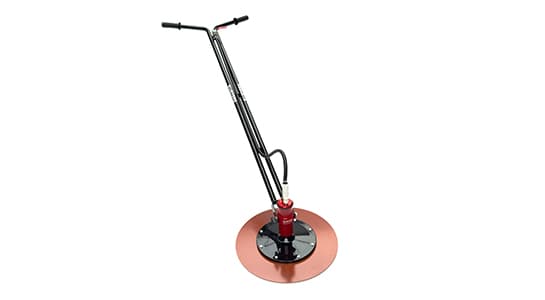
There is also a third option for the most sensitive environments. The Lievers LAP-45 is a pneumatic, walk-behind power float driven by an air motor rather than a petrol or electric one. Because it runs on compressed air, it produces no exhaust emissions and no sparks, so it can be used where combustion engines are unsafe — areas with an explosion or fire risk, or poorly ventilated enclosed spaces. Its air motor also tolerates damp, hot and acidic or saline conditions, and its speed can be adjusted steplessly from zero up to full working speed. For spark- and emission-sensitive work, pneumatic drive answers a problem that petrol and electric machines cannot.
Free advice
Our engineers in Mijdrecht think along about machine choice, concrete and planning — answer within one working day.
About the author
Lievers Holland has designed and manufactured concrete compaction and finishing machinery in Mijdrecht, the Netherlands, since 1954. Our guides are written by the same engineering team that builds the machines.
A power float is a powered machine that finishes fresh concrete by spinning steel blades or a flat pan over the surface. The rotating action compacts and burnishes the top layer into a flat, dense, hard and smooth floor. It is the standard tool for finishing industrial and commercial concrete slabs.
Yes. "Power float" and "power trowel" are used interchangeably for the same machine, and it is also nicknamed a "concrete helicopter" because the spinning blades resemble rotor blades. If people draw a distinction, it is usually between the two jobs the machine does: floating (an early pass with a float pan) and finishing or trowelling (later passes on the bare blades).
"Concrete helicopter" is a common site nickname for a power float, coming from the way its spinning blades look like helicopter rotors. A float pan is a separate part: a smooth round steel disc that clips over the blades for the early floating stage, spreading the machine's weight, embedding the aggregate and flattening a still-soft surface before the bare blades are used to finish it.
A power float is used to compact and smooth fresh concrete into a flat, dense, low-porosity floor. That surface resists abrasion, dust and liquids and is easy to clean, which is why power floating is standard for warehouse, factory, distribution-centre and other large industrial and commercial floors.
Petrol power floats are self-contained and need no external supply, making them handy for open outdoor slabs. Electric machines run cleaner and quieter with no exhaust, suiting enclosed or occupied spaces. Pneumatic machines, such as the Lievers LAP-45, run on compressed air and produce no exhaust or sparks, so they can be used where combustion engines are unsafe — for example in areas with explosion or fire risk or in poorly ventilated enclosed spaces.
Float first, finish second. Floating is an early pass, usually with a float pan on still-soft concrete, to flatten the surface and embed the aggregate. Finishing (trowelling) comes once the slab has stiffened: the bare blades run at a progressively steeper pitch to burnish the surface tighter and smoother as it hardens. Matching the timing to how the concrete is setting is key to a good result.
 How-to
A step-by-step guide to power floating and trowelling a concrete floor — when to start, floating versus trowelling, overlapping passes and blade pitch, working edges, and choosing a walk-behind or ride-on machine.
Read articleGuideA buyer's guide comparing walk-behind and ride-on power trowels — how each works, productivity and coverage, edge access, transport and cost, when to choose each, and how the two are combined on a single concrete pour.
Read article