Finishing
Choose a walk-behind power trowel for smaller floors, edges, columns and access-tight jobs where you need to steer close to obstacles on foot; choose a ride-on power trowel for large open slabs where a seated operator and two counter-rotating rotors finish far more square metres per hour. Most professional pours end up using both — the ride-on covers the open field while a walk-behind or edger works the perimeters the big machine cannot reach.
A power trowel (also called a power float) finishes fresh concrete once it has stiffened enough to walk on. Rotating steel blades or float pans skim across the surface, closing and densifying the top layer to leave a flat, smooth, hard-wearing floor. Every power trowel does the same basic job — the big choice is the machine format: a compact walk-behind the operator steers on foot, or a larger ride-on the operator sits on. Lievers has designed and built concrete compaction and finishing machinery in Mijdrecht, the Netherlands, since 1954, and this guide sets out how the two formats differ so you can match the machine to the floor.
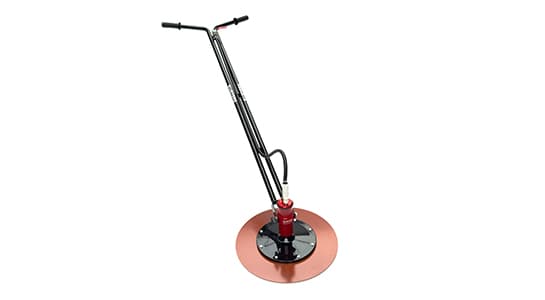
A walk-behind trowel is a single-rotor machine (Polish: *zacieraczka jednotarczowa*) with one disc or blade set turning under a guard ring. The operator walks behind it and steers by tilting the handle. Because it is light and compact, it can be lifted by one or two people, carried up stairs, and worked right up to walls, columns, door thresholds and formwork edges. Lievers builds a compact walk-behind float, the LAP-45, with a 450 mm disc and stepless 0–275 rpm speed control; it is air-motor driven rather than petrol-powered, so it produces no exhaust and no sparks and can be used in enclosed or fire-risk areas where a combustion machine cannot. That makes a walk-behind the natural tool for small rooms, repair patches, precast bays and the perimeter work no ride-on can reach.
A ride-on trowel (Polish: *zacieraczka dwutarczowa*) carries two counter-rotating rotors, each with five or six blades, spanning a finishing path around 2.3 m wide. The operator sits on the machine; a foot pedal sets blade speed while two joysticks tilt the rotors to steer forward, back and side to side. Blade pitch is adjusted from flat for early floating to progressively steeper for the final finishing passes. These machines are typically diesel-driven through a hydrostatic transmission, weigh roughly 880–980 kg, and run the rotors up to about 160 rpm. All of that mass and power goes into covering ground fast — which is exactly why they exist.
Choose a walk-behind when floors are small to medium, heavily cut up by columns and walls, or reached by stairs and doorways — and for all the edge and detail work on any job. Choose a ride-on when you are finishing large, open slabs — warehouses, distribution centres, industrial floors — where the area is big enough that its coverage and lower operator fatigue translate into real productivity and a more uniform finish.
On most large commercial floors the two formats are used together rather than as an either/or. The ride-on finishes the open field, moving in overlapping passes to keep the surface even, while a walk-behind trowel or a hand edger follows the perimeters, works around columns, and finishes the strip the ride-on leaves along every wall. Planning the pour this way lets each machine do what it does best: coverage from the ride-on, access from the walk-behind.
Both formats run in two modes. Float pans are round discs fitted over the blades; used early, on wetter concrete, they float the surface, ride easily between wet and dry patches, and help embed larger aggregate and dry-shake surface hardeners. As the slab hardens, the pans come off and the machine runs on finishing blades, with the pitch increased progressively pass by pass to burnish the surface tight and hard. Matching the mode and blade pitch to the concrete's stage — flat pans first, steeper blades last — is what separates a good finish from a marked or wavy one, on a walk-behind and a ride-on alike.
Free advice
Our engineers in Mijdrecht think along about machine choice, concrete and planning — answer within one working day.
About the author
Lievers Holland has designed and manufactured concrete compaction and finishing machinery in Mijdrecht, the Netherlands, since 1954. Our guides are written by the same engineering team that builds the machines.
Neither is universally better; they suit different floors. A walk-behind is better for smaller areas, edges, columns and access-tight or enclosed spaces, and it costs less and transports easily. A ride-on is better for large open slabs, where its two rotors and seated operator finish far more square metres per hour with less fatigue. On big pours the best answer is usually both — a ride-on for the field and a walk-behind for the perimeters.
You need a ride-on once slabs are large and open enough that a single-disc walk-behind can't keep pace with the concrete as it cures. Warehouse, distribution-centre and industrial floors of several hundred square metres and up are typical territory: the wider finishing path and lower operator fatigue let you finish the whole area within the window the concrete allows, and keep the finish uniform across it.
A ride-on carries two counter-rotating rotors spanning roughly a 2.3 m finishing path, against a single disc on a walk-behind, so it covers several times more ground per pass. Real-world productivity depends on slab layout and operator skill, but on large open floors a ride-on typically finishes concrete far faster than a walk-behind — which is the main reason to move up to one.
A walk-behind can finish an entire small or cut-up floor on its own. A large ride-on generally cannot, because it can't reach tight against walls and columns — the perimeter strip still needs a walk-behind trowel or a hand edger. That's why big pours are planned around both machines: the ride-on for the open field and a smaller machine for the edges and detail.
There's no single cut-off, but ride-on trowels earn their keep on large, open slabs — think industrial and warehouse floors of several hundred square metres or more, with room to manoeuvre. Below that, or on floors broken up by many columns, walls and doorways, a compact walk-behind is usually the more practical and economical choice.
A single-disc trowel (zacieraczka jednotarczowa) has one rotor — that's the walk-behind format, steered on foot and ideal for smaller areas and edges. A double-disc trowel (zacieraczka dwutarczowa) has two counter-rotating rotors — that's the ride-on format, sat on by the operator and built for covering large slabs quickly. The disc count is essentially what separates a compact walk-behind from a high-output ride-on.
 Explainer
A plain-language explainer covering what a power float (power trowel, "concrete helicopter") is, the difference between float pans and finishing blades, how the machine works, the finish it produces, walk-behind versus ride-on types, and petrol, electric and pneumatic power options.
Read articleHow-toA step-by-step guide to power floating and trowelling a concrete floor — when to start, floating versus trowelling, overlapping passes and blade pitch, working edges, and choosing a walk-behind or ride-on machine.
Read article