Concrete basics
Concrete compaction is the process of driving entrapped air out of freshly placed concrete so the mix densifies and settles fully around the reinforcement and into the formwork. It matters because even a small amount of trapped air leaves voids that sharply reduce the strength, watertightness and durability of the hardened concrete. Done well, compaction turns a loose, air-filled mix into a dense, sound structure.
When fresh concrete is placed, it doesn't arrive as a solid mass. The mix carries a large volume of entrapped air — pockets of air folded in during mixing, transport and placing — often 5–20% of its volume before it is worked. Concrete compaction (also called consolidation) is the process of removing that entrapped air so the particles pack closely together and the mix flows fully around the reinforcement and into every corner of the formwork. The goal is simple: replace air with concrete, leaving a dense, homogeneous material with no hidden voids.
This is not the same as curing, which controls how the concrete hardens over the following days. Compaction happens in the short window while the concrete is still plastic and workable, immediately after it is placed.
Entrapped air is far more damaging than most people expect. Air voids interrupt the continuous, load-bearing matrix of the concrete, and strength falls away steeply as the void content rises. A widely cited rule of thumb is that around 5% of trapped air can cut compressive strength by roughly 30% — so a mix designed for 30 MPa might deliver closer to 20 MPa if it is left poorly compacted.
Strength is only part of the story. Voids also open paths for water, chlorides and other aggressive agents to reach the reinforcement, accelerating corrosion of the steel and shortening the life of the structure. Poor compaction shows up as honeycombing — coarse, stony, gap-riddled surfaces where the cement paste never filled between the aggregate — and as blowholes on the finished face. In short, compaction is one of the cheapest and most decisive steps in getting durable, full-strength concrete, and one of the easiest to get wrong.
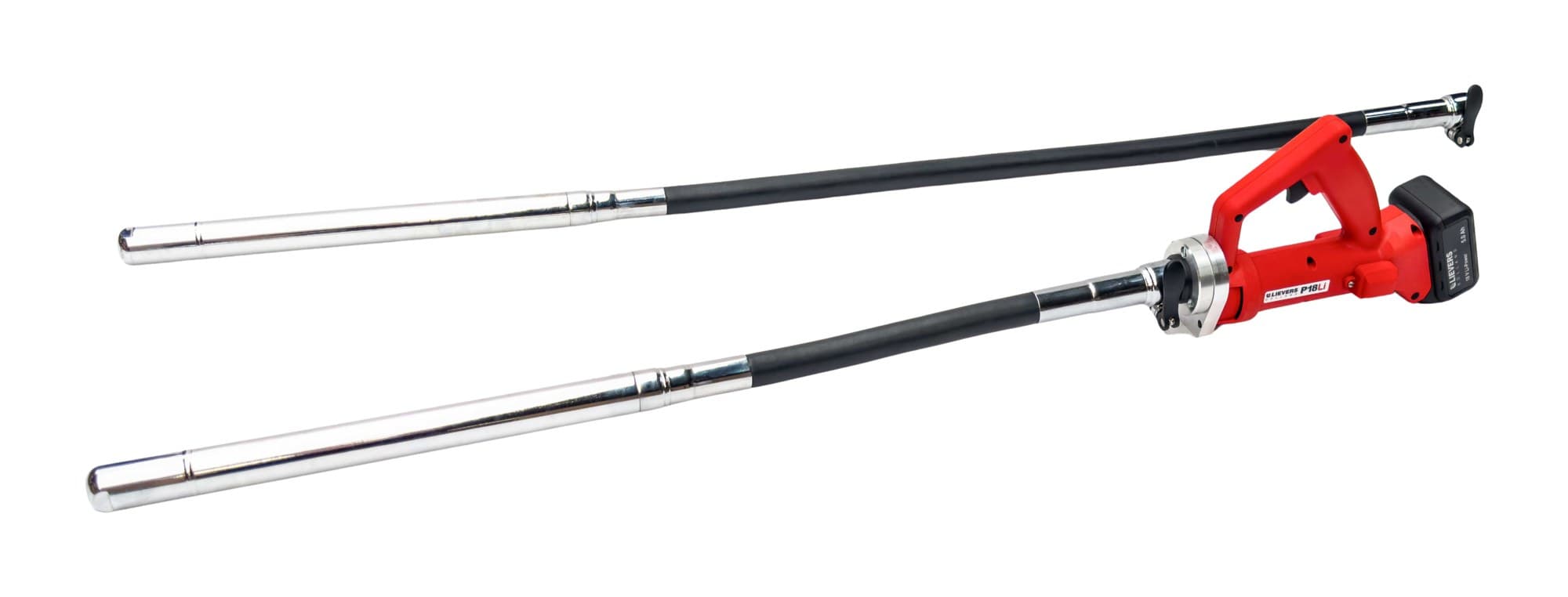
Most compaction relies on vibration. Fresh concrete behaves like a stiff, granular paste held in place by internal friction between the aggregate particles. Applying rapid vibration briefly overcomes that friction and effectively liquefies the mix: the particles lose their grip on one another, the heavier solids settle into a tighter arrangement, the fluid cement paste flows to fill the gaps, and the lighter entrapped air rises to the surface and escapes. When the vibration stops, the friction returns and the concrete holds its new, denser packing. High vibration frequencies are especially effective at reaching and moving the finer particles — internal poker vibrators such as the Lievers P18Li run at around 12,000 vibrations per minute for exactly this reason.
Different elements call for different tools, but almost all compaction falls into a few families:
In practice these are often combined: on a floor pour, a poker consolidates the full depth while a vibrating screed finishes the surface.
One modern mix does away with vibration altogether. Self-compacting concrete (SCC) is engineered with a highly flowable but stable consistency, so it de-airs and consolidates under its own weight, flowing around dense reinforcement without any mechanical input. SCC is valuable for congested elements and quiet, labour-light pours — but it is the exception that proves the rule, and it must not be vibrated, as that would cause the aggregate to segregate.
Well-compacted concrete has a closed, uniform surface with a thin sheen of cement paste, sharp arrises at the formwork, and no visible stone pockets. During the pour, good compaction shows itself when the air bubbles stop rising and the surface around a poker glazes over. Poor compaction, by contrast, leaves honeycombing and exposed aggregate, blowholes and sand streaks on vertical faces, and a generally rough, porous texture. It is worth remembering that over-vibration is a fault too: vibrate too long and the mix segregates, the heavy aggregate sinking while a weak, watery layer of paste rises to the top. The aim is enough vibration to release the air — and no more.
Lievers Holland has designed and built concrete compaction and finishing machinery in Mijdrecht, the Netherlands, since 1954, and the principles above underpin every tool in the range.
Free advice
Our engineers in Mijdrecht think along about machine choice, concrete and planning — answer within one working day.
About the author
Lievers Holland has designed and manufactured concrete compaction and finishing machinery in Mijdrecht, the Netherlands, since 1954. Our guides are written by the same engineering team that builds the machines.
Concrete compaction, or consolidation, is the process of removing entrapped air from freshly placed concrete so the mix densifies and settles fully around the reinforcement and into the formwork. Fresh concrete can contain 5–20% air by volume before it is worked; compaction — usually by vibration — drives that air out to leave a dense, homogeneous material.
Because entrapped air voids sharply reduce both strength and durability. Air pockets break up the load-bearing matrix, so compressive strength drops steeply as void content rises, and the same voids let water and chlorides reach the reinforcement and corrode it. Good compaction is one of the cheapest, most decisive steps in getting full-strength, long-lasting concrete.
Uncompacted concrete keeps its trapped air as permanent voids. That shows up as honeycombing — coarse, stony, gap-riddled surfaces — plus blowholes, low strength, poor watertightness and a much higher risk of reinforcement corrosion. The finished element can fall well short of its designed strength and have a significantly shorter service life.
The main methods are internal (poker) vibration, where a vibrating head is immersed in the pour for walls, columns and slabs; external or form vibration for thin, congested sections and precast; surface vibration with vibrating screeds and beams for floors; hand or mechanical tamping for small pours; and vibrating tables for precast units. On floor pours a poker and a screed are often used together.
It depends on how much air is left in the mix, but the effect is large. A widely cited rule of thumb is that around 5% of entrapped air can reduce compressive strength by roughly 30% — so a mix designed for 30 MPa might deliver closer to 20 MPa if it is poorly compacted. Higher void contents cause even greater losses.
Yes. Self-compacting concrete (SCC) is designed to be highly flowable yet stable, so it de-airs and consolidates under its own weight and flows around dense reinforcement without any vibration. It is the one common mix that needs no mechanical compaction — and it must not be vibrated, as that would make the aggregate segregate.
 How-to
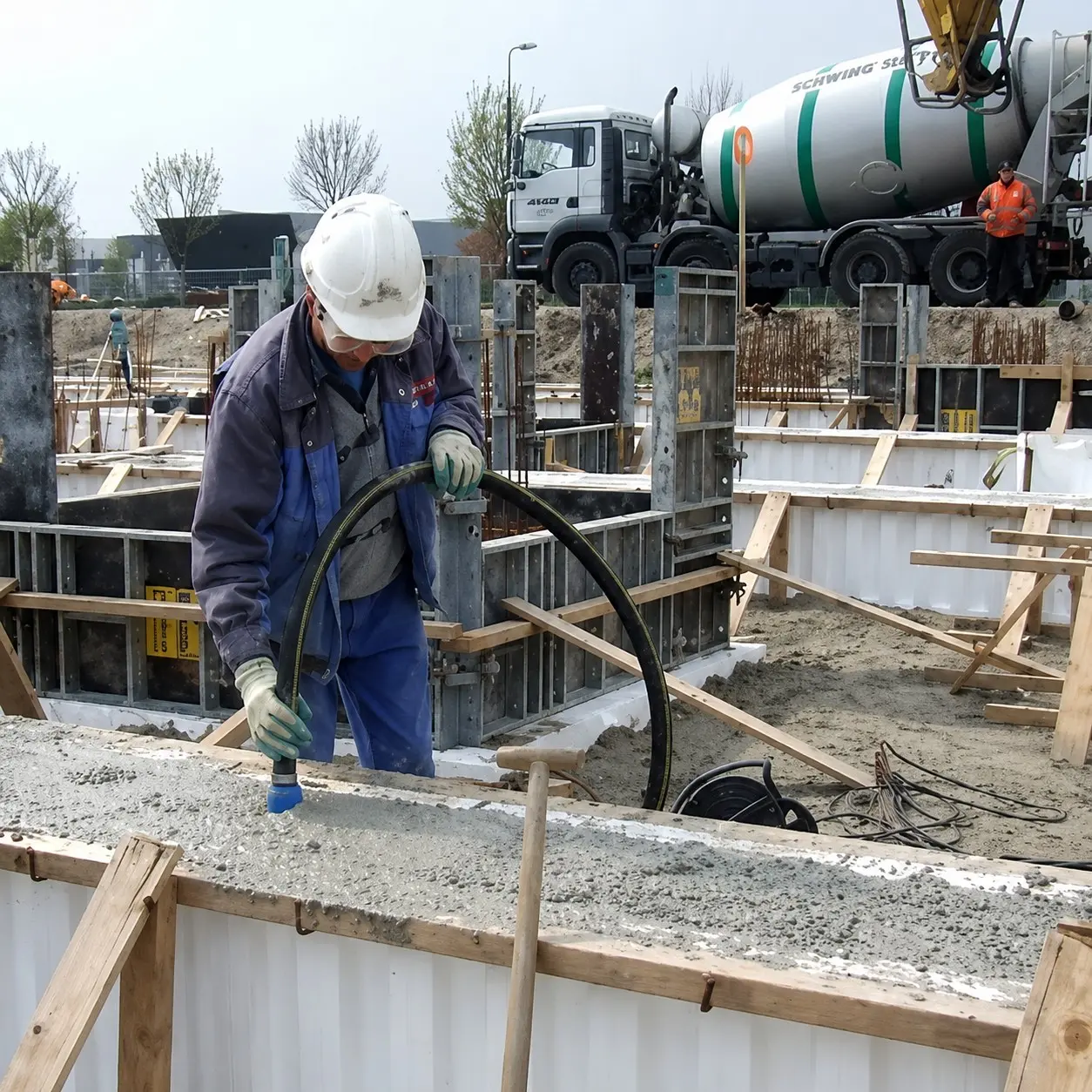
A step-by-step guide to compacting fresh concrete with an internal poker (immersion) vibrator — insertion technique, spacing, how long to vibrate, and how to avoid over-vibration.
Read articleExplainerA plain-language explainer of poker (internal) concrete vibrators — what they are, how the vibrating head consolidates fresh concrete, the main power types, how head diameter is chosen, and when to use one instead of a surface method.
Read article